
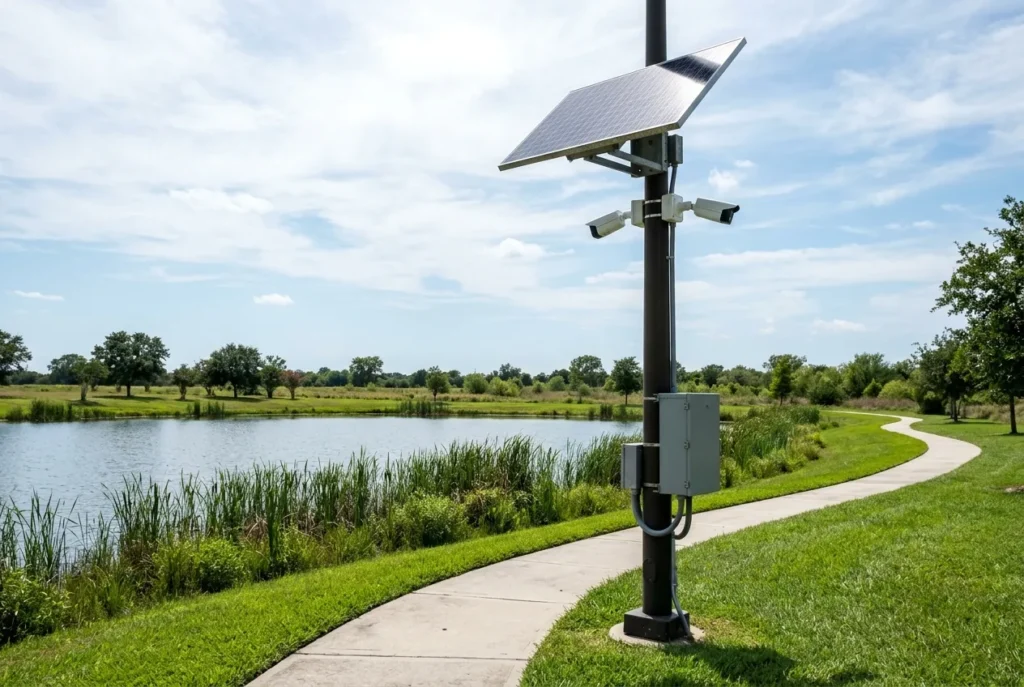
Three ways to power a remote camera
| Option | When it fits | What’s involved |
|---|---|---|
| Existing power | A pool building, monument light or irrigation panel nearby | Tap existing power where it’s safe and allowed |
| New electrical service | Power is close enough to bring in economically | We coordinate the electrician, utility work and trenching or boring |
| Solar | No practical power source, or trenching would cost more than the system | Solar panel, batteries and a pole-mounted camera system |
Solar systems built for Houston
- Panels and batteries sized for short winter days and runs of cloudy weather, not best-case sunshine. Our solar systems are built to stay online for several weeks with minimal sunlight.
- Equipment mounted high on poles, out of reach and secured against theft
- Motion-based recording to save power and cellular data
- Enclosures rated for heat, humidity and storms
Cellular service, handled by us
Remote cameras need a data connection, usually cellular. With other installers, boards often end up holding their own carrier account, and when something goes wrong, nobody knows whether to call the carrier or the installer. We supply and manage the cellular service ourselves. One contact, no separate carrier bill to track.
Good fits for solar cameras
- Detention ponds
- Trails and greenbelts
- Secondary entrances
- Parks away from the amenity center
- Dumping hot spots
- Construction phases of new sections
Common questions
What happens after several cloudy days?
The battery bank carries the system through. HealthDesk alerts us if a site’s power or connection drops, so we know before the board does.
Can solar sites have live video monitoring?
Yes, on any system we install.
Do we need permission to install on a pond or easement?
Sometimes. Ponds and easements may belong to a MUD, the county or another owner, and we sort that out during the assessment, before the board commits.